Wrist2Finger: Sensing Fingertip Force for Force-Aware Hand Interaction with a Ring-Watch Wearable
Oct 1, 2025·,,,,,,·
0 min read
Yingjing Xiao
ZhiChao Huang
Junbin Ren
Yuting Bai
Haichuan Song
Zhanpeng Jin
Yang Gao
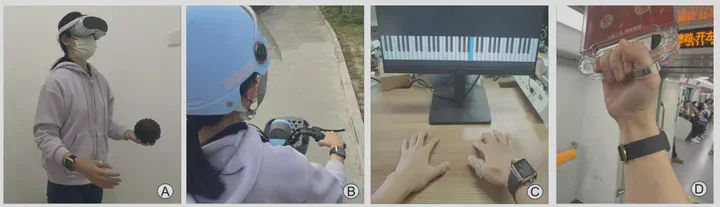 Figure 1 from the paper.
Abstract
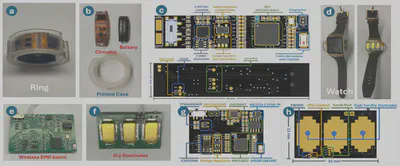
Hand pose tracking is essential for advancing applications in human-computer interaction. Current approaches, such as vision-based systems and wearable devices, face limitations in portability, usability, and practicality. We present a novel wearable system that reconstructs 3D hand pose and estimates per-finger forces using a minimal ring-watch sensor setup. A ring worn on the finger integrates an inertial measurement unit (IMU) to capture finger motion, while a smartwatch-based single-channel electromyography (EMG) sensor on the wrist detects muscle activations. By leveraging the complementary strengths of motion sensing and muscle signals, our approach achieves accurate hand pose tracking and grip force estimation in a compact wearable form factor. We develop a dual-branch transformer network that fuses IMU and EMG data with cross-modal attention to predict finger joint positions and forces simultaneously. A custom loss function imposes kinematic constraints for smooth force variation and realistic force saturation. Evaluation with 20 participants performing daily object interaction gestures demonstrates an average Mean Per Joint Position Error (MPJPE) of 0.57 cm and a fingertip force estimation (RMSE: 0.213, r=0.76). We showcase our system in a real-time Unity application, enabling virtual hand interactions that respond to user-applied forces. This minimal, force-aware tracking system has broad implications for VR/AR, assistive prosthetics, and ergonomic monitoring.
Type
Publication
Proceedings of the 38th Annual ACM Symposium on User Interface Software and Technology (UIST 2025)